

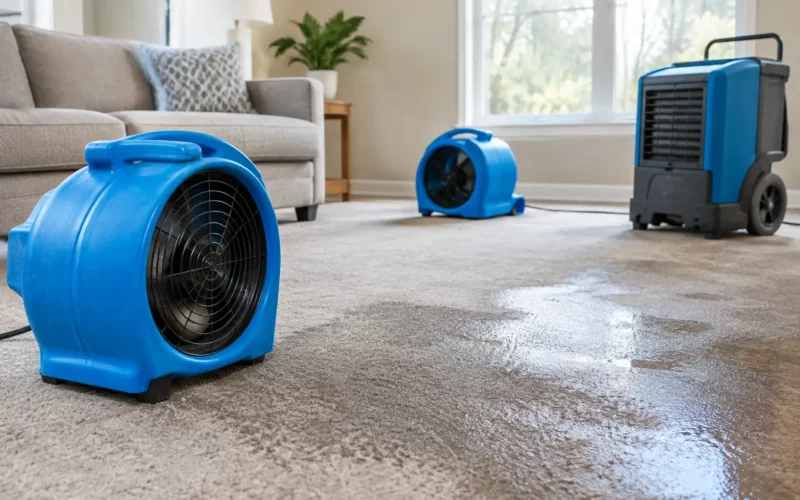
A burst flexi hose under a bathroom vanity can put enough water into an adjoining bedroom carpet to create a serious restoration job within minutes. This flooded carpet drying example shows what a professional response can look like over the first 48 hours, and why simply opening windows or hiring a fan is rarely enough when water has soaked through the carpet and underlay.
The central goal is not to make the carpet feel dry on top. It is to remove water, dry all affected materials to an appropriate level, and reduce the chance of mould growth, odours, staining and damage to the subfloor or nearby walls.
The scenario: clean water reaches a carpeted room
Imagine a homeowner returns from work to find water has escaped from a failed tap connection. The leak has been running for several hours. Water has travelled from the tiled ensuite into the carpeted bedroom, soaking approximately one-third of the room.
Because the source is a clean mains-water supply, the water may initially be treated as Category 1, or clean water. That classification matters, but it does not make the situation minor. Clean water can quickly become contaminated after sitting in carpet, underlay, dust and building materials. A prompt response gives the best chance of drying and restoring the affected carpet rather than replacing materials unnecessarily.
Before any drying starts, the water source must be isolated and the area made safe. If water is near power points, electrical equipment or wiring, do not enter the area until it is safe to do so. Move furniture only where it can be done safely, and avoid walking water further through the home.
Flooded carpet drying example: the first visit
A trained technician begins by inspecting the affected room and identifying how far moisture has travelled. The visible wet patch is only part of the picture. Moisture can move underneath the carpet, wick into skirting boards, enter walls and spread beneath furniture where it is not immediately obvious.
Moisture meters and other assessment equipment help establish the affected area and provide a baseline for drying. Technicians may compare readings in wet materials with unaffected parts of the property. This avoids guesswork and helps determine whether the carpet, underlay and subfloor can be dried in place.
Step 1: Extraction comes before drying equipment
The first practical task is water extraction. A professional extractor removes as much liquid water as possible from the carpet before air movers and dehumidifiers are positioned. This step has a major effect on drying time. The less water left in the carpet and underlay, the more efficiently the remaining moisture can evaporate.
For a lightly affected, clean-water incident caught early, the carpet may be lifted at an edge and assessed underneath. In some cases, the underlay can be dried or replaced while the carpet itself is retained. If the underlay is saturated, compressed or likely to hold contamination, removal is often the more reliable option. It depends on the water category, how long the carpet has been wet, the construction of the flooring and the condition of the materials.
Furniture is raised on protective blocks or moved from the wet zone where practical. Timber furniture should not sit directly on damp carpet, as moisture can cause staining, warping or transfer of dyes and finishes.
Step 2: Set up controlled drying
After extraction, drying equipment is placed to create consistent airflow across the damp carpet and exposed surfaces. Air movers increase evaporation by moving air across wet materials. Dehumidifiers then remove moisture from the air, allowing the drying process to continue rather than simply moving humid air around the room.
Doors, windows and air conditioning are considered as part of the drying plan. Opening windows can help in some conditions, but Sydney humidity and wet weather can also slow drying by bringing more moisture-laden air indoors. Controlled mechanical drying is more dependable than relying on weather conditions alone.
The room may look much improved after the first visit, but it is not yet confirmed dry. The carpet can feel dry at the surface while the underlay, subfloor edges or wall base remain wet. This is one reason flood restoration should be measured rather than judged by touch.
What happens on day two
At the follow-up inspection, technicians check moisture readings again and assess the progress of each affected material. In this example, the carpet surface may be nearly dry, while the timber subfloor near the ensuite wall still shows elevated moisture. The equipment is adjusted to focus drying where it is needed.
This monitoring is an essential part of professional restoration. Removing drying equipment too early can leave trapped moisture behind. Leaving it running without checking conditions can also be inefficient. The right approach is based on verified readings, not a fixed number of hours.
If the incident was discovered quickly and the water remained clean, the carpet may be salvageable with extraction, cleaning and controlled drying. A professional clean after drying can help remove soil drawn to the surface during the water event and leave the carpet in a hygienic condition.
However, there are situations where drying alone is not appropriate. If water came from a toilet overflow, sewage backup, stormwater runoff or another contaminated source, the carpet and underlay may not be safe to restore. Grey or black water contamination requires a more cautious response, and affected porous materials may need to be removed. Health and safety must take priority over saving a carpet.
The 48-hour outcome
By the end of the second day, a well-managed clean-water incident may have the carpet, subfloor and adjacent building materials at acceptable drying targets. Only once readings confirm this should equipment be removed and furniture returned to its normal position.
The final result is more than a carpet that looks dry. It is a room checked for residual moisture, treated with suitable equipment and returned to use with a lower risk of lingering damp smells, mould and secondary damage.
A larger flood, a leak that has gone unnoticed for days, or water affecting multiple rooms will require a longer process. Concrete slabs, timber flooring, insulation, built-in wardrobes and plasterboard walls all change the drying plan. No two water damage jobs are identical, which is why assessment at the property matters.
What to do while help is on the way
A quick and sensible response can make a real difference. First, stop the source of water if it is safe to do so. Keep people and pets away from electrical hazards, then move loose items, rugs and furniture from the wet area where possible. Blot small pools of clean water with towels, but do not use a household vacuum on wet carpet.
Avoid lifting carpet yourself unless you understand what is underneath and can do so without damaging it. Avoid applying heat directly to the carpet, as rapid or uneven heating can create other problems. Most importantly, do not assume a wet carpet will dry properly on its own. Underlay and subfloor moisture are frequently missed in DIY attempts.
For renters, notify the landlord or property manager promptly and document the incident with clear photos. For businesses, isolate the affected space, protect stock and keep staff away from wet flooring until the area has been assessed.
Why a fast professional response matters
Flooded carpet restoration is time-sensitive because water continues to travel through absorbent materials. Acting early improves the likelihood of saving carpet and reduces disruption to the household or workplace. Certified technicians bring extraction equipment, moisture detection tools and managed drying systems that are designed for this type of work.
Sydneywide Carpet Cleaning provides emergency flooded carpet restoration across Sydney, with experienced technicians focused on practical drying outcomes and careful treatment of soft furnishings. Whether the cause is a burst pipe, appliance leak or overflowing bathroom, a prompt assessment provides a clear path forward.
If carpet is wet after a water incident, treat it as a drying project rather than a cleaning task. The most useful next step is to have the moisture assessed early, while there is still time to protect the materials beneath your feet.