

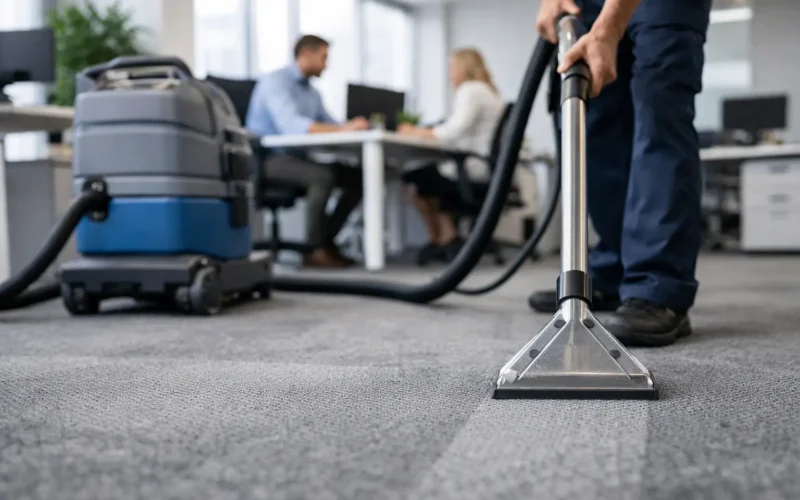
That grey traffic lane from the lift to the boardroom is usually the first sign a workplace is overdue for an office carpet cleaning service. The carpet might still look passable in a photo, but staff notice the stale smell, clients notice the marks near reception, and embedded soil keeps wearing the fibres down every day.
For most offices, carpet cleaning is not just about appearances. It affects presentation, indoor hygiene, and how long the flooring lasts before replacement becomes a much bigger job. In busy commercial spaces, soil, dust, moisture and spills do not sit on the surface for long. They work their way into the pile, especially in walkways, under desks, around meeting areas and near kitchenettes.
A professional approach deals with more than visible stains. It targets the build-up that routine vacuuming cannot remove and helps restore a cleaner, fresher working environment. That matters in offices where foot traffic is constant, where staff spend long hours indoors, and where the condition of the premises reflects directly on the business.
Why an office carpet cleaning service matters
Office carpets put up with far more punishment than most people realise. Daily foot traffic brings in fine grit, outdoor dirt, moisture and allergens. Chairs with castors grind debris deeper into the fibres. Coffee spills, food drops and tracked-in rainwater create isolated problems that can quickly become ongoing ones if they are not treated properly.
Over time, that build-up changes the carpet in two ways. First, it affects how the office looks and smells. Second, it shortens the life of the carpet by increasing abrasion in high-use areas. Dirt is not harmless once it is embedded. It acts like a fine abrasive, and that wear shows up as dull, flattened paths long before the carpet should be near the end of its service life.
There is also the hygiene factor. In enclosed workplaces, carpets can hold dust, allergens and residues that are difficult to remove with standard in-house cleaning. Professional maintenance helps reduce that load and supports a cleaner environment for staff and visitors.
What a professional clean should actually achieve
A proper commercial carpet clean should do more than leave the floor damp and smelling of deodoriser. The goal is to remove embedded soil, treat spots appropriately, improve the overall appearance of the carpet and support healthier indoor conditions.
That process starts with identifying the carpet type and its condition. Not every office carpet responds the same way. Some low-pile commercial carpets are built for heavy traffic and can handle more aggressive cleaning methods. Others, particularly in executive suites or fitted-out meeting rooms, may need a more tailored approach to protect the fibres and backing.
A trained technician will also look at the type of soiling involved. Dry soil, oily residues, food spills and water marks all behave differently. If everything is treated the same way, the result is usually patchy. Good cleaning is as much about choosing the right method as it is about having the right equipment.
Common methods used in office carpet cleaning service work
Hot water extraction is one of the most effective methods for many office environments because it flushes out deep soil and residues from the carpet pile. When carried out correctly with commercial-grade equipment, it provides a thorough clean without leaving heavy residue behind. It is often a strong option for periodic restorative cleaning or scheduled maintenance in high-traffic workplaces.
Low-moisture cleaning can also be suitable, especially where fast turnaround is important. Some offices need cleaning outside business hours and want carpets ready for use again as quickly as possible. In those cases, the best method depends on the carpet construction, the level of soiling and how the space is used.
This is where experience matters. The fastest method is not always the best one, and the deepest clean is not always necessary every single visit. In practice, many offices benefit from a maintenance plan that balances interim cleaning with more intensive periodic treatments.
How often should office carpets be cleaned?
There is no single schedule that suits every workplace. A small administrative office with limited public traffic may need less frequent deep cleaning than a busy city office with constant staff movement, client visits and shared common areas.
High-traffic zones such as entrances, hallways, reception areas and meeting rooms usually need attention sooner than private offices. If the workplace has food service areas, frequent drink spills or wet weather foot traffic, the cleaning cycle often needs to be tighter.
The practical way to think about it is this: if the carpet already looks tired, smells stale or shows clear traffic lanes, it is overdue. Waiting until the carpet looks heavily soiled means more wear has already occurred. Regular maintenance is usually the better long-term decision because it keeps presentation consistent and helps preserve the carpet rather than trying to rescue it after neglect.
Signs your office needs professional carpet cleaning
Some signs are obvious, such as staining near desks, dark walkways or marks around entry points. Others are easier to miss because they build gradually. A general dullness across the floor, lingering odours after vacuuming, or an office that never seems to feel fully fresh can all point to deep-set soil in the carpet.
Another sign is uneven appearance. If some sections still look acceptable but main paths are flat and discoloured, that often means embedded grit and wear are concentrated where traffic is highest. Professional cleaning can improve those areas, although results depend on how much permanent wear has already occurred.
That distinction matters. Cleaning removes soil and many stains, but it cannot reverse fibre damage once the carpet has been physically worn down. The earlier maintenance starts, the better the outcome tends to be.
Choosing the right office carpet cleaning service
Not all commercial cleaning providers approach carpet care with the same level of training or attention to standards. For office managers and facility teams, reliability matters just as much as the cleaning result. The provider needs to turn up when arranged, work with minimal disruption, and use methods suited to the site.
It also helps to choose a team with experience across different commercial settings. Offices vary widely, from compact professional suites to large multi-room premises with reception zones, workstations, break areas and after-hours access requirements. A capable provider understands how to assess those spaces properly and plan the clean around business operations.
Look for certified and trained technicians, modern equipment, and a clear understanding of maintenance cleaning as well as problem-solving for spills or water damage. In a commercial setting, responsiveness matters. If an unexpected issue affects the carpet, delays can quickly turn a manageable problem into a larger restoration job.
For workplaces across Sydney, that local knowledge can also make a difference. Access conditions, building requirements and response times are all easier to manage when the service team is used to working across a broad metro area.
Office carpet cleaning service and staff wellbeing
Carpet cleaning is often treated as a purely visual maintenance task, but the impact goes further. Staff spend a large part of the week inside the office, and the condition of soft surfaces contributes to how clean the environment feels.
Dust, tracked-in debris and stale residues do not create a good impression, even if they are not immediately obvious. A professionally maintained carpet supports a workplace that feels more cared for and more comfortable to use. That may sound simple, but small environmental factors influence how people experience a space.
For businesses that welcome clients on site, this matters even more. Reception and meeting areas say a lot about how a company runs its operations. Clean carpets help those spaces look well managed without drawing attention to themselves, which is exactly what you want from flooring.
Maintenance works better than last-minute fixes
The most effective carpet care is proactive. Spot cleaning after accidents is useful, and urgent treatment has its place, but relying only on reactive cleaning usually leads to inconsistent results. Carpets stay in better condition when they are maintained on a sensible schedule based on traffic, usage and the building environment.
That approach also makes it easier to deal with localised issues before they spread or set. A coffee spill near a workstation, moisture tracked in from wet weather, or repeated marks near a kitchenette can often be managed far more effectively when the carpet is already part of a professional maintenance program.
Experienced operators such as Sydneywide Carpet Cleaning understand that office carpet care is not one-size-fits-all. The right plan depends on the workspace, the carpet, and the daily demands placed on it.
A clean office carpet does not need to call attention to itself. It should simply help the whole workplace feel fresher, present better, and stand up to daily use with less fuss.